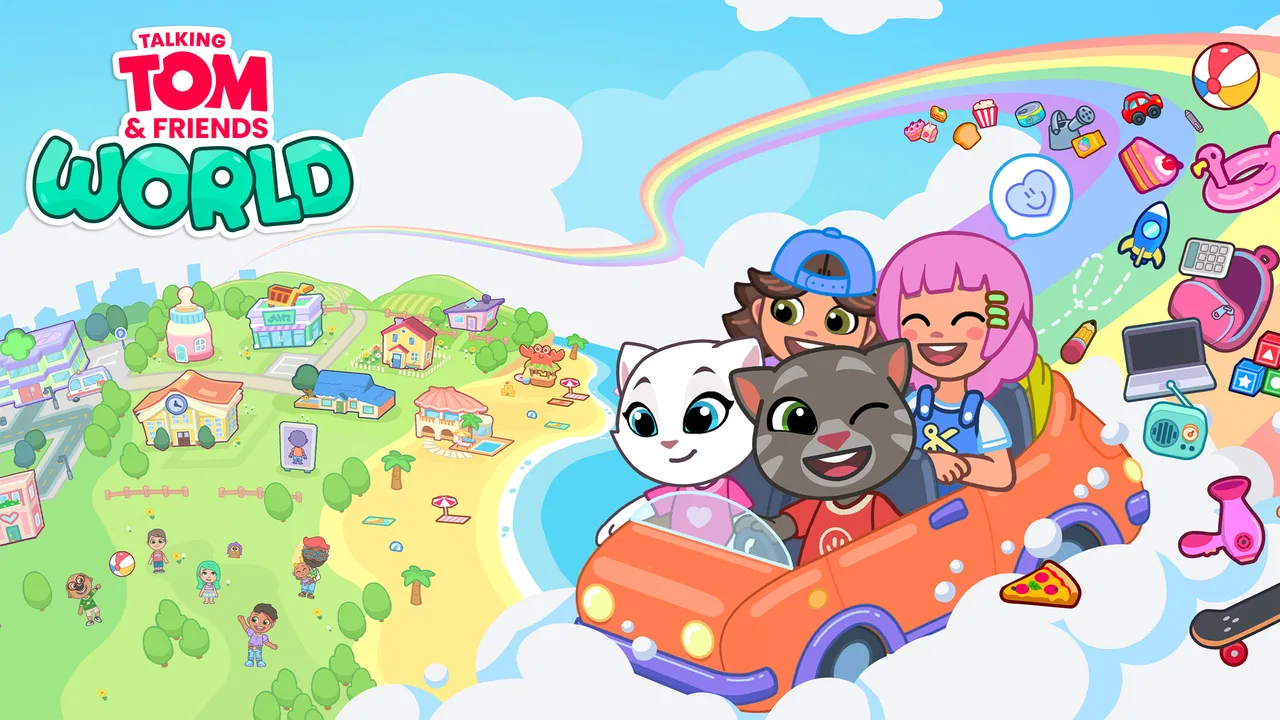
Talking Tom & Friends: World
- 3.2
- Rating
- 10.00M
- Installs
- Free
- Price

 Analysis by App-foxy
I went into Talking Tom & Friends: World expecting a light, character-led experience for younger players, and that is exactly where it makes the most sense. This free education app from Outfit7 Limited places Talking Tom and his familiar friends at the centre of an open-ended world built around imagination, exploration and simple play. It is less like a traditional lesson app and more like a friendly digital space where a child can invent small stories and return to favourite characters.
That distinction matters. Parents looking for structured reading, mathematics or language instruction will probably find more direct teaching in a dedicated learning app. Here, the educational value comes through conversation, pretend play, discovery and the freedom to decide what happens next. I found the experience easiest to appreciate when I treated it as a supervised creative break rather than a replacement for schoolwork.
What the first week feels like
The first few sessions are carried by recognition. Talking Tom and his friends give the app an immediate personality, so a child does not have to learn an unfamiliar cast before becoming interested. The world invites the player to imagine a personal story, and that simple premise is more effective than a long explanation. A young user can begin by exploring and experimenting instead of worrying about rules or performance.
You May Also Like

 Blood Strike: 2.5 Anniversary
Blood Strike’s Loadouts Turn Every Drop Into a Tactical Gamble
A close look at Blood Strike’s custom loadouts: how fast access to signature weapons reshapes its battle royale rhythm, rewards preparation, and narrows the gap between fights.

 Pandora - Music & Podcasts
Pandora’s Music Is Easy to Start, but Harder to Recover
Pandora’s strength is its low-effort path from a seed to a station. Its weak spot is how much confidence it asks you to place in connection, setup, and quiet recovery.

 8 Ball Pool
 Is Built on Rivalries, Rematches, and Routine
A close look at the rivalries, rematches, shared routines, and unanswered safety questions that turn a quick pool match into a persistent mobile community.

 Samsung Music
’s Quiet Strength Is Playing What You Already Own
Its reach comes less from spectacle than from dependable access to a personal library. That simplicity is both the app’s strongest retention engine and its ceiling.

 AccuWeather: Weather Radar
AccuWeather Review: A Quick, Clear Forecast for Everyday Decisions
For everyday plans, the best forecast is the one you can understand quickly. AccuWeather makes rain timing, radar, and local conditions easy to act on, with a few trade-offs.

 Hill Climb Racing
Why Hill Climb Racing Still Turns Crashes Into One More Run
A tiny car, a bumpy hill and one more upgrade: Hill Climb Racing keeps resurfacing because its simple chaos makes every near-miss feel personal.
More From Our News Desk



I also liked that the app is approachable for the whole family. Its content rating is Everyone, and it runs on Android devices using version 6.0 or later, which makes it accessible to many older phones and tablets as well as newer hardware. The current version is 1.5.1.20634. Those details do not guarantee identical performance on every device, but they do make the app a practical candidate for a family device that is not brand new.
During the first week, the strongest use case is a short, shared session. A parent can sit nearby and ask a child to explain what the characters are doing, why a story changed or what might happen next. That turns passive tapping into a small storytelling exercise. Even without formal worksheets, the child is practising sequencing, vocabulary and decision-making in a natural way.
A useful habit is to let the child lead the first few minutes, then ask one open question rather than taking over. “What is happening here?” works better than directing every action. I found this approach helps reveal whether the child is genuinely interested in the world or simply responding to bright characters. It also keeps the app from becoming another adult-controlled activity.
The free entry point is important. There is no purchase required to try the app, so families can judge its appeal before committing money. At the same time, in-app purchases range from fifty-nine cents to two hundred nineteen dollars and ninety-nine cents per item. That is a very wide range, and it makes device-level purchase controls essential, especially when a child is exploring independently.
I would not hand over a payment-enabled device without first checking how purchases are protected. This is not a criticism unique to this title, but it is particularly relevant here because the characters and playful setting are designed to encourage continued interaction. A child may understand that something is “in the game” without understanding that it can also cost real money.
Where the educational value really comes from
The app’s learning value is informal rather than curriculum-based. Children can practise imagination by creating situations for the characters, communication by describing those situations and flexible thinking by trying different actions. That can be meaningful, but it depends heavily on how the app is used. If a child only repeats the same familiar interaction, the benefit may settle into simple entertainment.
For that reason, I would use it alongside conversation. After a session, ask the child to retell the story without looking at the screen, draw one of the characters or invent a different ending. These small follow-ups make the experience last longer than the tapping itself. They also help parents see whether the app is encouraging original thought or merely holding attention.
This is one of the less obvious strengths of a character-driven world: it gives a child an easy starting point for pretend play. A blank drawing app can be intimidating, while a familiar cast provides a prompt. The trade-off is that the child’s imagination is still framed by the personalities and setting supplied by the app. It supports creativity, but it does not offer the same open canvas as a general art or storytelling tool.
Will it still matter after the novelty fades?
The first-week appeal is clear, but long-term value is a tougher question. Character familiarity can bring a child back, yet recognition alone does not create a lasting habit. The app earns repeat visits when the child uses it to make a new story, explore with a sibling or talk with a parent. It becomes less compelling when each visit follows the same path and produces the same kind of moment.
In my experience, the best month-to-month routine would be occasional rather than automatic. A few short sessions each week can leave room for anticipation and conversation. Leaving the app open as a default source of entertainment may have the opposite effect: the world can start to feel like background noise, and the child may move on to a faster-changing game.
That makes it a poor choice for families seeking a single app that will provide fresh, structured learning every day. A dedicated educational platform is usually better for measurable progress, planned lessons and clear skill levels. A creative sandbox or drawing app may also be a stronger choice for children who want to build things from scratch instead of playing inside a cast-led world.
On the other hand, this app has an advantage over many formal alternatives when the goal is to lower the barrier to creative play. A child who resists flashcards may happily explain what Tom and his friends are doing. A child who finds a blank page difficult may invent a story because the characters make the first step easier. That emotional accessibility is real value, even though it is harder to measure than a completed lesson.
A realistic everyday routine
Imagine a child coming home after school and needing a calm transition before dinner. I would set a clear time limit, let the child choose the direction of the story and stay close enough to hear the conversation. When the session ends, I would ask for a two-sentence summary: who was involved, what happened and what could happen tomorrow. This turns a short visit into a repeatable language activity without pretending the app is formal homework.
For a younger child, a parent can model descriptive words and ask simple either-or questions. For an older child, the same world can become a prompt for more detailed storytelling. The app itself does not need to carry the entire educational burden. Its role is to provide characters and a setting that make talking easier.
Another practical use is sibling play. One child can choose the situation while another decides what a character should do next. This can encourage turn-taking, although it may also expose a limitation: children who want competitive goals, clear winners or advanced challenge may find the experience too gentle. It is better suited to cooperative imagination than to skill-based competition.
Maintenance, spending and the effort required from parents
Maintenance is not only about updates or storage. It is also about keeping the experience purposeful. Because the app is free and character-led, the main parental task is setting boundaries around time, purchases and the difference between play and learning. Those decisions are manageable, but they should be made before the child develops an unrestricted routine.
The broad purchase range deserves particular attention. Free access makes testing easy, but optional items can change the family’s relationship with the app. I would explain clearly that digital additions are not necessary for the child’s story to count, then use the device’s purchase safeguards. This protects the budget and reduces the pressure to buy something simply because it appears during play.
There is also a maintenance burden in keeping the content fresh through the child’s own choices. Instead of asking whether the app has enough novelty, I would create a small rotation of prompts: a new setting, a problem for the characters to solve, a retelling from another character’s point of view or a story with no spoken words. These prompts cost nothing and can extend the useful life of the same world.
That approach reveals an important trade-off. The app may offer a convenient starting point, but the adult often supplies the deeper variety. Families wanting an entirely self-refreshing experience may become disappointed. Families willing to add a question or two can get more value without turning every session into a lesson.
Technical compatibility is relatively broad because the minimum Android requirement is 6.0, but I would still test it on the actual family device before promising it to a child. Older hardware can behave differently from newer hardware, particularly when a world contains several animated characters or interactive areas. I would also keep the app updated when practical, since the installed version can affect the experience over time.
On iOS, the sensible approach is the same: check the current device requirements in the relevant store before installing. The important point is not to assume that a child-friendly app will feel equally comfortable on every screen size. A tablet is generally easier for shared play, while a phone is more convenient for short individual sessions.
Why some children may tire of it
The biggest source of fatigue is repetition. Familiar characters are excellent at attracting attention, but they can also make the world feel predictable once the initial discovery is over. If a child is looking for constant surprises, increasingly difficult challenges or a clear sense of progression, this may not hold interest for long.
Another possible frustration is the gap between the store promise of imagining and exploring and what a particular child expects from a game. Some children hear “world” and expect a large, highly interactive environment with extensive goals. Others are satisfied with a smaller space for role-play. I would watch the child’s behaviour rather than relying on the label: are they inventing scenarios, or are they quickly asking for another app?
The educational category can also create unrealistic expectations. This is not the same kind of tool as a phonics course, a mathematics trainer or a language-learning program. Its educational contribution is strongest when an adult connects the play to speech, storytelling and reflection. Without that connection, it may function mainly as character entertainment.
There is a further trade-off between convenience and independence. A child can use a familiar character world with little explanation, but younger users may still need help understanding choices, managing purchases and stopping at an agreed time. Parents who want a completely hands-off activity should take that into account.
I would also skip it for a child who dislikes branded characters or prefers building systems, puzzles and concrete objectives. The Talking Tom identity is central to the experience, not a minor decoration. If the child wants open-ended construction, serious creative tools or a more demanding game loop, another category will probably be a better match.
Who gets the most from it over time?
The best audience is a young child who enjoys pretend play and already responds positively to Talking Tom’s world. It can also suit families looking for a gentle shared activity that encourages a child to speak about what they see. The free price makes the trial decision easy, while the Everyone rating makes it approachable for a broad family audience.
The app is less suitable for parents who need visible academic outcomes. If your priority is practising a particular school skill, choose a tool designed around that skill and use this one only as a creative supplement. It is also not ideal for children who need strong challenge to stay engaged. The absence of pressure is comforting for some users and under-stimulating for others.
The developer, Outfit7 Limited, has built a recognizable setting that does much of the motivational work. That is why the app can succeed where a neutral activity might fail: the child already has a reason to care about the characters. But the same branding can narrow the appeal. A child who has outgrown Talking Tom may not find enough reason to return, regardless of how friendly the world feels.
The public response suggests a mixed but substantial audience: the app holds a 3.7 average from around ten thousand ratings, with over five million installs and one hundred sixty-seven written reviews. I read that as evidence of broad curiosity rather than proof that it will suit every household. The numbers show reach, but the more useful test is whether your child continues creating stories after the first few visits.
My long-term verdict
After the novelty fades, I think Talking Tom & Friends: World can earn a place on a family device, but not as an always-on educational solution. Its lasting value comes from how easily it starts conversations and pretend scenarios. If I use it briefly, protect purchases and add my own prompts, I can see it supporting language and imagination in a relaxed way.
The app is worth keeping when it becomes a springboard for a child’s own stories, not when it is used simply to fill silence. That is the key distinction. The characters provide motivation, while the parent or child supplies the variety. Without that extra layer, repeated visits may become routine and the educational benefit may feel thin.
I would recommend trying the free version for a week, observing whether the child invents anything beyond the obvious interactions and deciding from there. If the child asks to revisit a story, explains character choices and enjoys changing the outcome, the app is doing something useful. If interest disappears once the first excitement passes, uninstalling it is a reasonable choice rather than forcing a habit.
For families wanting a gentle, familiar and conversation-friendly experience, this is a pleasant option. For formal learning, deep creativity or demanding gameplay, I would choose a more specialized alternative. My final view is positive but measured: it can deliver recurring value, yet that value depends on active, thoughtful use rather than the app maintaining itself.
FAQs for Talking Tom & Friends: World
01What is Talking Tom & Friends: World about?
Talking Tom & Friends: World is an interactive game where players can join Tom and his friends on various adventures. The game offers a mix of mini-games, puzzles, and creative activities. Players can explore different worlds, customize characters, and engage in fun challenges, making it suitable for all ages.
02Is Talking Tom & Friends: World free to play?
Yes, Talking Tom & Friends: World is free to download and play. However, it does offer in-app purchases for additional features, items, and customizations. These purchases are optional but can enhance the gameplay experience. Make sure to manage in-app purchase settings if children are playing.
03What age group is Talking Tom & Friends: World appropriate for?
Talking Tom & Friends: World is designed for players of all ages, but it is particularly appealing to children and families. The game features kid-friendly content, vibrant graphics, and simple controls, making it easy for younger players to navigate and enjoy. Parental guidance is recommended for in-app purchases.
04Are there any educational benefits to playing Talking Tom & Friends: World?
While Talking Tom & Friends: World is primarily a source of entertainment, it can offer educational benefits such as enhancing creativity, problem-solving skills, and hand-eye coordination. The game encourages exploration and strategic thinking through its various challenges and activities, making learning fun.
05Can Talking Tom & Friends: World be played offline?
Talking Tom & Friends: World primarily requires an internet connection to access all features and updates. However, some activities may be available offline. To ensure the best experience and access to new content, it’s recommended to play while connected to the internet.
Pros
- Engaging animations for all ages.
- Wide variety of mini-games included.
- Customizable character outfits.
- Interactive and responsive gameplay.
- Regular updates with new content.
Cons
- In-app purchases can be costly.
- Requires constant internet connection.
- Ads can interrupt gameplay.
- Limited offline features.
- Can be repetitive after a while.

Talking Tom & Friends: World
Gallery